1. WHAT ITEMS DO I NEED TO GIVE AN INTRAMUSCULAR (IM) INJECTION?
-
The correct size needle and syringe
-
Medication vials
-
Alcohol wipes
-
Optional: Gloves for the individual administering the injection
2. WHERE CAN I ADMINISTER AN IM INJECTION?
There are many sites on the body that are safe to give intramuscular injections. Please follow the injection site directions as detailed by your medical provider or use these instructions as a guide.
Precautions:
-
It is important to follow these instructions so you do not give the injection directly into nerves, blood vessels, joints or bone.
-
Rotate where you give injections. Scar tissue can accumulate and negatively affect the potency of the medication if you give an injection in the same place every day or even every week.

Ventrogluteal Muscle (Hip)
This site is considered safe due to its well-defined landmarks and minimal risk of hitting blood vessels or nerves.
-
Place your thumb at the base of your tailbone and move it straight across, halfway to your hip.
-
Put your index finger about 2 inches (5 cm) below the ridge of your hip bone. The V-shaped area between your thumb and index finger is the ventrogluteal muscle.
Vastus Lateralis Muscle (Thigh)
This is the preferred site for self-injections because it is easy to locate and reach.
-
To find this muscle, divide your top thigh area into three equal parts – top (near your hip), middle, and bottom (near your knee).
-
Put your thumb in the middle of the top of the thigh and your fingers along the side. This is the correct muscle location.
Deltoid Muscle (Shoulder)
This site is commonly used when another person is administering the injection. You can receive the injection while sitting, standing, or lying down.
-
Visualize an upside-down triangle on the outer part of your upper arm.
-
Locate the acromion process, the bony ridge at the top of the upper arm.
-
The base of the triangle is 1 to 2 inches (2.5 to 5 cm) below the acromion process.
The correct injection site is in the center of the triangle, directly below the midpoint of the base.
3. HOW TO DRAW MEDICATION INTO A SYRINGE?
-
Wash your hands thoroughly with soap and dry them completely. Wear gloves if needed.
-
Remove the plastic cap from the medication vial and clean the rubber stopper with an alcohol wipe.
-
Take a new syringe, remove the needle cap, and pull back the plunger to draw in an amount of air equal to your prescribed medication dosage.
-
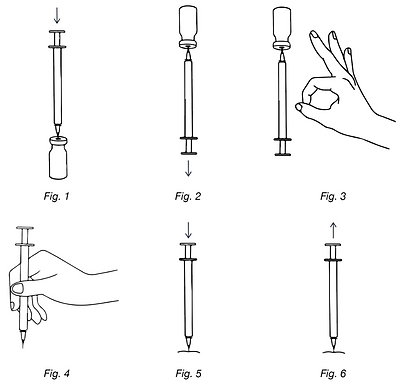
Insert the needle into the vial and slowly push the air into the vial. This helps balance the pressure inside, making it easier to withdraw the liquid. (Fig. 1)
-
With the needle still inside, turn the vial upside down and carefully pull back the plunger to draw the correct amount of medication into the syringe. (Fig. 2)
-
If air bubbles appear in the syringe, gently tap the barrel with your fingers to move the bubbles toward the top, then push them out through the needle. A small amount of medication may also come out, which is normal. (Fig. 3)
-
The syringe is now ready for injection.
4. HOW DO I INJECT THE MEDICATION INTO MY BODY?
-
After following all preparation steps, hold the syringe in your dominant hand. Grip it between your thumb and first finger, allowing the barrel to rest on your second finger, similar to holding a pen. (Fig. 4 above) Clean the injection site with an alcohol wipe and let it air dry.
-
With your other hand, gently stretch and hold the skin taut, positioning your fingers slightly away from where you plan to insert the needle.
-
Using a quick, controlled motion from your wrist, insert the needle at a 90-degree angle (straight in), similar to how you would throw a dart. Avoid pushing the needle in too slowly or forcefully, as this could cause discomfort or bruising. The sharp needle should penetrate the skin smoothly when inserted correctly. (Fig. 5)
-
Release the skin while keeping the syringe steady and pointed straight in.
-
Carefully pull back the plunger slightly to check for blood. (Fig. 6)
**If blood appears in the syringe, you may have hit a blood vessel. Remove the needle, properly dispose of the syringe and medication, and prepare a new dose using a fresh syringe. Choose a different injection site for the next attempt.**
-
If no blood is present, press down firmly on the plunger to inject the medication. Some medications may cause slight stinging upon injection.
-
Once the medication is fully administered, quickly remove the needle at the same angle it was inserted.
-
Safely dispose of the used syringe and needle in a Sharps Container.
5. HOW TO SAFELY DISPOSE OF USED SYRINGES AND NEEDLES
A Sharps Container is the safest way to dispose of used syringes and needles. These hard-plastic containers are specifically designed for this purpose and can be purchased at most pharmacies.
If you don’t have a Sharps Container, you can use a sturdy, hard-plastic container with a secure screw-on lid—such as an empty detergent or fabric softener bottle. Ensure the container is durable enough to prevent needles from puncturing the sides, bottom, or lid.
For proper disposal, check your local or state regulations. You can contact your primary care provider or a nearby pharmacy for guidance on safe disposal options in your area.
